🧠 Sleek Design: The Aesthetics and Functionality That Define Modern Products
A 2,500-Word In-Depth Guide for Brands, Marketers, and Shoppers
🔹 Part 1: Introduction – What Does “Sleek Design” Really Mean?(~400 words)
In today’s world of high-performance gadgets and appliances, design is no longer an afterthought — it’s a primary factor in purchase decisions. Whether it’s a smartphone, a sandwich maker, a laptop, or a smart speaker, one term keeps popping up across product pages and advertisements: “sleek design.”
But what does sleek design actually mean?
At its core, sleek design refers to a product that is visually appealing, minimalistic, and smooth in both appearance and usability. It often combines a slim profile, elegant finishes, ergonomic curves, and smart spatial planning. A product with a sleek design not only looks modern but also feels intuitive and premium.
More importantly, sleekness is not just about looks. It is a design philosophy that embraces:
Compactness without compromise
Functionality wrapped in form
Beauty in simplicity
From the curved edges of a smartphone to the glossy finish of a sandwich maker, sleek design is what gives a product that “wow” factor — making it desirable, photogenic, and easy to use.
As consumer expectations shift toward minimalism and convenience, brands that prioritize sleek design stand out in crowded marketplaces.
Sleek Design: The Philosophy of Effortless Sophistication
Introduction: The Allure of the Streamline
We live in a world shaped by lines. From the silent glide of a high-speed train to the seamless interface of a smartphone, from the unadorned facade of a modern skyscraper to the intuitive curve of a chef’s knife, an aesthetic principle whispers a promise of efficiency, elegance, and progress. This principle is sleek design. It is more than a style; it is a philosophy, a relentless pursuit of essence. It is the visual and experiential manifestation of the idea that less can be more, that complexity can be made simple, and that true sophistication lies not in addition, but in subtraction.
The word “sleek” itself is evocative. It brings to mind the hydrodynamic form of a dolphin cutting through water, the glossy, contained energy of a predator, the smooth, unruffled surface of a calm sea. It implies a lack of resistance, a frictionless interaction with the world. In design, to be sleek is to achieve a state of resolved completeness, where every element is justified, every line serves a purpose, and the whole object or system feels inevitable.
This treatise is an exhaustive examination of sleek design. We will dissect its historical roots, from the nascent stirrings of modernism to the digital age. We will unpack its core tenets—minimalism, functionality, sophistication, and the profound role of materials and technology. We will trace its application across diverse fields: product design, architecture, automotive design, technology, and graphic user interfaces. We will explore the cultural and psychological implications of living in a “sleek” world, and finally, we will peer into the future, considering the sustainability and ethical dimensions of this enduring aesthetic. This is not merely a catalog of sleek objects, but a deep dive into the ideology that creates them.
Part I: The Foundations of Sleek – A Historical and Philosophical Framework
Chapter 1: Precursors to Sleek – From Ornament to Object (1850-1920)
The birth of sleek design is a story of rebellion. It emerged as a direct counterpoint to the excessive ornamentation of the Victorian era and the fluid, organic, yet often still decorative, forms of Art Nouveau. The seeds were sown by movements and thinkers who began to question the very purpose of design.
The Arts and Crafts Movement: While often associated with handicraft and traditional techniques, the movement, led by figures like William Morris, introduced the crucial idea of “fitness to purpose.” Morris’s famous dictum, “Have nothing in your houses that you do not know to be useful, or believe to be beautiful,” laid the groundwork for a honesty in design that would later be stripped of its rustic aesthetic.
The Deutsche Werkbund: Founded in Germany in 1907, the Werkbund was a pivotal organization that sought to integrate traditional crafts with industrial mass-production. Its goal was to create well-designed, high-quality machine-made products. This marriage of art and industry was a necessary precursor to the sleek aesthetic, which is inherently tied to technological production methods.
Adolf Loos and “Ornament and Crime”: Perhaps no text is more fundamental to the philosophy of sleek design than Adolf Loos’s 1908 essay. Loos provocatively argued that ornamentation was a sign of cultural degeneracy, equating it with the tattoos of “primitive” peoples. For Loos, the evolution of culture was synonymous with the removal of ornament. The plain, smooth, undecorated surface of a modern object was, to him, a sign of spiritual and intellectual advancement. This radical purism is the ideological bedrock of sleekness.
🔹 Part 2: Characteristics of a Sleek Design(~500 words)
A sleek design is the result of deliberate design choices that prioritize both aesthetics and usability. Let’s break down the main characteristics:
✅ 1. Slim Profile
One of the most obvious features of a sleek product is its thin and streamlined silhouette. Whether it’s a smartphone under 8mm thick or a compact toaster that tucks neatly into a cabinet, thickness matters in sleekness.
✅ 2. Smooth Surfaces & Clean Lines
Sleek designs avoid clutter. Clean, uninterrupted lines and smooth finishes are key elements. Glossy or matte finishes, brushed metals, or smooth-touch plastics enhance the tactile and visual appeal.
✅ 3. Minimal Buttons & Clutter
Instead of overwhelming the user with buttons and indicators, sleek designs simplify the interface. Think touch controls, single-dial operations, or multi-function buttons.
✅ 4. Integrated Components
In sleek appliances, components like handles, locks, and displays are often seamlessly integrated into the body. This gives a polished, unified appearance and reduces visual noise.
✅ 5. Color and Material Harmony
Most sleek products come in neutral or modern color palettes — blacks, silvers, whites, greys, or even pastels. Materials like stainless steel, tempered glass, or high-grade polymers contribute to the luxurious yet understated vibe.
✅ 6. Space Efficiency
A sleek design often means a compact footprint without sacrificing performance. Whether in a kitchen or office, a sleek product fits neatly into its environment, maximizing available space.
🔹 Part 3: Why Sleek Design Matters to Consumers(~400 words)
In the era of minimalism and smart homes, sleek design isn’t just a buzzword — it’s a buying motivator. Here’s why:
✅ 1. Blends with Modern Interiors
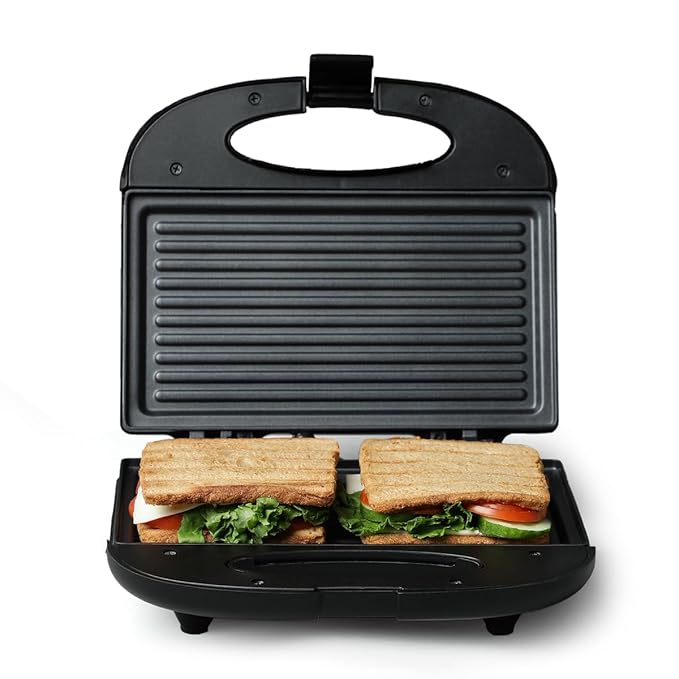
Today’s homes are more design-conscious than ever. Consumers want appliances and gadgets that complement their decor, not disrupt it. A sleek sandwich maker or air fryer doesn’t need to be hidden in a cabinet — it becomes part of the aesthetic.
✅ 2. Professional Appeal
Whether it’s a corporate office or a creative studio, sleek gadgets project professionalism and style. A laptop with a sleek metallic finish or a speaker with minimal curves looks far more high-end and capable.
✅ 3. Perceived Value
Sleek design increases the perceived value of a product. Even when two appliances offer similar features, the one with the sleeker design will often be seen as more premium — and can command a higher price.
✅ 4. Ergonomic & User-Friendly
Sleek doesn’t mean shallow. In fact, sleek designs often come with improved usability. Think of an iron with a tapered handle or a sandwich maker that stores vertically — form meets function.
and security cameras are adopting sleek designs that blend into their environments. They often feature touch-sensitive surfaces, hidden ports, and voice-led controls.
🔹 Part 5: The Psychology Behind Sleek Design(~300 words)
Sleek design taps into psychological triggers like:
Simplicity bias – Our brains are wired to prefer clean, uncomplicated visuals.



Reviews
There are no reviews yet.