
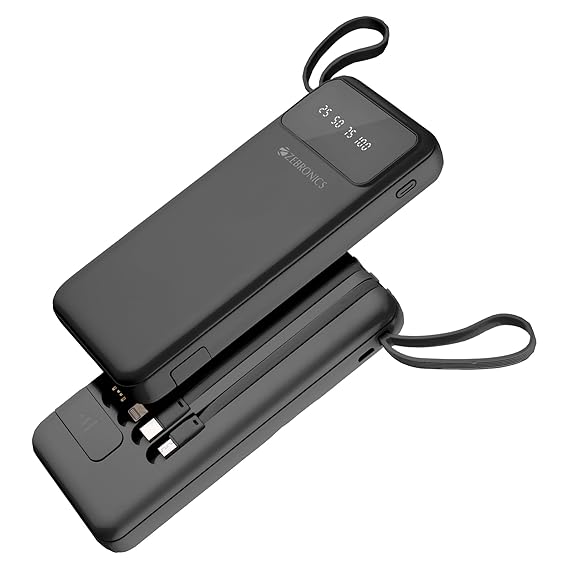
[Efficient charging capacity]: The ZEB-MB10000S6 power bank features an impressive 10000mAh battery capacity and rapid 2A input/output, ensuring swift and efficient charging to minimize downtime.
ZEBRONICS MB10000S6 Power Bank, 10000 mAh, 12W, 5 x Outputs – Dual USB A | Type C |Micro USB Input| Lightning, Built in I/O Cables, Percentage Display, Carry Loop, Made in India (Black) with Cable Included
1899 ₹ Original price was: 1899 ₹.649 ₹Current price is: 649 ₹.
SKU: N/A
Category: POWERBANK
Description
-
Cable Included
-
The Paradigm Shift of “Cable Included”: A Comprehensive Analysis of Integrated Charging Solutions in Modern Power Banks
I. Introduction: The Unbundling Problem and the Rise of Integrated Solutions
The phrase “Cable Included” has undergone a fundamental transformation in the context of modern portable power solutions. Historically, this term simply indicated that a manufacturer provided a basic charging cable within the product packaging—a separate accessory that could easily be lost, forgotten, or damaged. However, with products like the ZEBRONICS MB10000S6 power bank, “Cable Included” has evolved into something far more revolutionary: it signifies the strategic integration of permanent, built-in charging cables directly into the device’s form factor.
II. Historical Context: The Era of Cable Clutter
To fully appreciate the significance of built-in cables, one must understand the historical landscape of portable device charging.
A. The Pre-Integrated Era (The Age of Fragmentation)
For over a decade, the consumer electronics market was characterized by a proliferation of proprietary and standardized connectors. From the early days of manufacturer-specific ports to the gradual standardization around USB, the constant has been the cable as a separate, fragile, and easily lost component. Power banks were essentially dumb batteries with output ports; their functionality was entirely dependent on external accessories that were not always included in the package. The “Cable Included” promise was often fulfilled by a short, low-quality cable that served as a bare-minimum solution.B. The Psychological and Practical Burden
This separation of power source and connector created significant user friction:-
The “Forgotten Cable” Scenario: A fully charged power bank becomes useless if the required cable is left at home or in the office.
-
The “Cable Tangled Mess” Problem: Carrying multiple cables for different devices resulted in a tangled knot at the bottom of bags, wasting time and causing frustration.
-
The “Compatibility Anxiety”: Users had to constantly verify that they possessed the correct cable for each specific device, adding a layer of cognitive load to the simple act of charging.
The integrated cable design directly attacks these pain points, offering a self-contained solution that promises readiness at all times.
III. Technical Engineering and Design Implementation
The incorporation of permanent cables into a power bank is a non-trivial engineering challenge that involves careful consideration of form, function, and durability.
A. Mechanical Design and Durability
The most critical engineering challenge is the stress point management where the cable exits the power bank’s housing. Unlike a removable cable, which distributes wear across a replaceable component, a built-in cable’s failure at the junction point could render the entire power bank unusable. To counter this, manufacturers employ several techniques:-
Strain Reliefs: Thick, flexible rubber or plastic sleeves are molded at the cable’s exit point. These components absorb bending stresses and prevent the internal wires from being fatigued or severed through repeated flexing.
-
Internal Anchoring: The cables are securely anchored to the internal PCB (Printed Circuit Board) or the power bank’s chassis using clips, adhesives, or soldered connections that are designed to withstand pulling forces.
-
Cable Retraction Mechanisms (in some models): While the ZEBRONICS model features loose cables, some advanced designs include spring-loaded retractable reels. These protect the cable length when not in use, preventing tangling and reducing physical exposure, though they add mechanical complexity and potential failure points.
B. Electrical Integration and Circuitry
The built-in cables are not attached to standard ports; they are soldered directly onto the power bank’s main circuit board. This has several implications:-
Efficiency: A direct solder connection can, in theory, offer slightly better power transfer efficiency than a removable cable plugged into a port, as it eliminates the small resistance inherent in the port’s connector pins.
-
Charging Intelligence: The power bank’s internal charging controller can be optimized for the specific characteristics of the integrated cables, ensuring stable voltage and current delivery.
-
Simultaneous Charging Management: The power distribution circuitry must be intelligently designed to handle the load when both the built-in cables and the additional output ports are used concurrently. This requires robust power management ICs (Integrated Circuits) that prevent overheating and ensure safe operation under multi-device charging scenarios.
C. Material Science and Cable Longevity
The cables themselves are subject to different material choices than standard accessory cables.-
Conductor Quality: While often not as high-grade as premium aftermarket cables, the internal conductors must be sufficient to handle the advertised charging currents (e.g., 2.4A) without significant voltage drop. Cable Included
-
Insulation and Jacketing: The external jacketing needs to be resistant to abrasion, oils, and repeated coiling. Materials like TPE (Thermoplastic Elastomer) are common for their flexibility and durability.
-
Connector Design: The connectors at the end of the built-in cables (e.g., the Lightning or Micro-USB head) are built to withstand frequent insertion and removal cycles. Their design is often reinforced to prevent the port breakage that can plague cheap, removable cables. Cable Included
IV. The User Experience (UX) Transformation
The impact of integrated cables on the daily user experience is profound and multifaceted.
A. The Principle of “Always-Ready” Utility
The primary UX benefit is the elimination of pre-charging preparation. The power bank is perpetually in a state of readiness. A user with a low-battery iPhone need only retrieve the power bank and unfold the built-in Lightning cable. This reduces the steps required to initiate charging from a multi-step process (find power bank, find cable, connect cable) to a single, fluid action. This “grab-and-go” functionality is invaluable in time-sensitive or mobile situations.B. Reduction of Cognitive Load and “Decision Fatigue”
By providing the most commonly needed cables (Lightning and Micro-USB in the case of the ZEBRONICS model), the power bank reduces the mental energy required to manage device charging. The user is freed from the questions: “Do I have the right cable?” and “Where did I put the cable?” This aligns with modern design principles aimed at reducing user friction and creating seamless technological interactions. Cable IncludedC. Portability and Cable Management Cable Included
Integrated cables, even if not retractable, significantly simplify what a user must carry. There is no need for a separate cable pouch or to wind cables neatly. The cables can be looped and secured to the power bank itself, often with the aid of a carry loop or elastic band, creating a single, compact unit. Cable Included This is a major advantage for travelers, students, and professionals who prioritize a minimalist carry.V. Economic and Environmental Implications Cable Included
Cable Included
The shift towards integrated cables has significant ramifications beyond mere convenience. Cable Included
A. Economic Model: Value Addition and Product Differentiation
For manufacturers like ZEBRONICS, integrating cables is a powerful strategy for product differentiation. In a crowded market, a power bank with built-in cables offers a tangible, easily understandable advantage over competitors that sell “naked” power banks. This added value can justify a slightly higher price point and create a stronger value proposition for the consumer, who might otherwise have to purchase cables separately.B. The Environmental Calculus: E-Waste Reduction vs. Product Longevity
The environmental impact is a double-edged sword: Cable Included-
Potential for E-Waste Reduction: By reducing the need for consumers to purchase multiple, often short-lived, cheap cables, integrated designs could theoretically lower the production of cable-based electronic waste. A single, durable integrated cable replaces the need for several disposable ones.
-
The Challenge of Repairability: The major environmental drawback is the loss of modularity. If a built-in cable fails, the entire power bank may need to be replaced, whereas a failed removable cable is a simple, cheap fix. This creates a potential for increased e-waste if the product’s durability does not match its non-repairable design. The environmental benefit, therefore, hinges entirely on the product’s build quality and lifespan. A well-built power bank with cables that last for the device’s entire life is a net positive; a poorly built one is an e-waste liability. Cable Included
VI. Psychological and Sociological Impact
The integration of cables subtly influences user behavior and perception. Cable Included
A. Perception of “Smart” and “Thoughtful” Design
Products with integrated solutions are often perceived as more intelligent and user-friendly. They demonstrate that the manufacturer has anticipated the user’s needs and solved a problem before it even arises. This builds brand trust and customer satisfaction, fostering a perception of the brand as being innovative and customer-centric.B. The “Hassle-Free” Social Experience
In social or group settings, a power bank with built-in cables becomes a more accessible shared resource. Offering a charge to a colleague or friend is simplified; there is no need to ask “What kind of cable do you need?” or worry about the hygiene of sharing a cable that goes into one’s mouth (as with headphones). The available cables are simply there, ready to be used, facilitating a more seamless and generous social interaction.VII. Comparative Analysis: Built-in Cables vs. The Competition Cable Included
A. Vs. Traditional Power Banks (Cable Not Included): The advantage is clear: convenience, reduced accessory burden, and an “always-ready” state. The traditional model offers more flexibility in cable choice (e.g., using a high-quality, long braided cable) but at the cost of constant management. Cable Included
B. Vs. Power Banks with Wireless Charging: Wireless charging offers a different kind of cable-free convenience. However, it is typically slower and less efficient than wired charging. The ideal solution, emerging in premium models, is a combination of both: built-in cables for fast, reliable charging and a wireless pad for convenience with compatible devices. The ZEBRONICS model’s approach is a more cost-effective and universally compatible solution focused on reliability. Cable Included
VIII. The Future of Integrated Power Solutions Cable Includedk
The trend of integration is likely to continue and evolve. Cable Included
-
Standardization on USB-C: As the industry moves towards USB-C as a universal port, future power banks may feature multiple built-in USB-C cables or a single USB-C cable with adapters for legacy devices.
-
Modular and Magnetic Systems: Future designs might feature interchangeable magnetic cable tips that click onto a base cable integrated into the power bank, offering a compromise between the permanence of built-in cables and the flexibility of removable ones. Cable Included
-
Increased Focus on Durability: As this design becomes more popular, consumer demand will push manufacturers to improve the durability of these integrated cables, making them more resilient to the rigors of daily use.Cable Included
IX. Conclusion: The Integrated Cable as a Benchmark for User-Centric Design
While it presents challenges in terms of repairability and long-term durability, its benefits in daily convenience, reduction of cognitive load, and overall user satisfaction are immense. It transforms the power bank from a passive power reservoir into an active, ready-to-serve charging companion. This analysis demonstrates that this seemingly small design choice is, in fact, a significant leap forward in making technology simpler, more reliable, and more seamlessly integrated into our mobile lives. The era of the tangled, forgotten cable is being ushered out, replaced by the elegant, self-contained utility of the integrated power solution.
-
Additional information
| COLOUR | BLACK, LAVENDER |
|---|
Be the first to review “ZEBRONICS MB10000S6 Power Bank, 10000 mAh, 12W, 5 x Outputs – Dual USB A | Type C |Micro USB Input| Lightning, Built in I/O Cables, Percentage Display, Carry Loop, Made in India (Black) with Cable Included” Cancel reply
Related products
-
Sale!


Ambrane Magsafe Wireless with best power bank
2999 ₹Original price was: 2999 ₹.1399 ₹Current price is: 1399 ₹. -
Sale!


Amzon Basics 10000mAh 20W Fast Charging with wireless power bank
5999 ₹Original price was: 5999 ₹.1299 ₹Current price is: 1299 ₹. -
Sale!

ZEBRONICS MB10000S6 (V1) Power Bank, 10000 mAh, 12W, 5 x Outputs – Dual USB A | Type C | Micro USB | Lightning, Built in I/O Cables, Percentage Display, Carry Loop, Made in India (Black) with Multiple Outputs
1899 ₹Original price was: 1899 ₹.619 ₹Current price is: 619 ₹.Select options This product has multiple variants. The options may be chosen on the product page Details
Reviews
There are no reviews yet.