
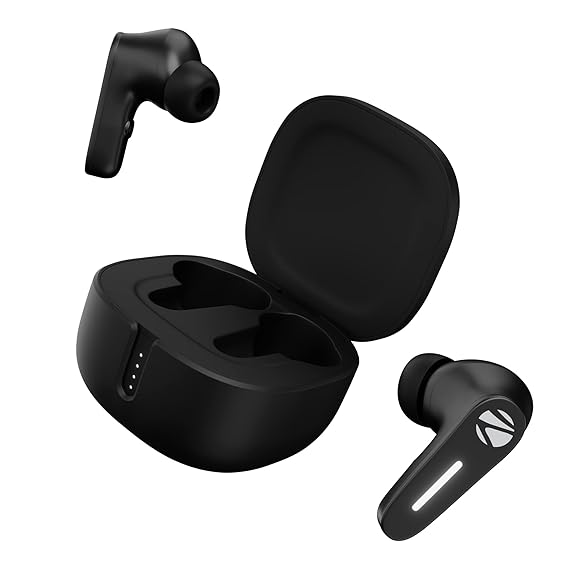
The all new SOUND BOMB 7 with 40H* of backup time and a Rapid charge feature which gives 180min* of backup with just 10min of charging! (*depends on usage conditions)
ZEBRONICS Sound Bomb 7 Bluetooth TWS in Ear Earbuds with 60H Playtime, ENC Mic, Rapid Charge, Upto 50ms Gaming Mode, Flash Connect, Voice Assistant, Smooth Touch Control, BT v5.2, Type C (Black) with Voice Assistant
Original price was: 4299 ₹.749 ₹Current price is: 749 ₹.
Description
-
Voice Assistant
- The all new SOUND BOMB 7 with 40H* of backup time and a Rapid charge feature which gives 180min* of backup with just 10min of charging! (*depends on usage conditions)
- Get ready and game for hours together with the 50ms Low latency Gaming mode in ZEB-SOUND BOMB 7 TWS earbuds
- The earbuds support Environmental Noise Cancellation providing smooth calling experience by canceling a significant amount of external / traffic noise
- With 13mm driver configuration, you can now vibe for songs like never before! Punchy bass, sharp Treble and a warm vocal tone will provide you with the best sound signature
- Stay protected from accidental spills or splash, as the earbuds support a splash proof / sweat proof design. Make it your workout companion, right noOf course. Here is a comprehensive description of the **”Voice Assistant”** feature in modern devices like smartwatches, earbuds, and smartphones.
—
### **Voice Assistant: The Conversational Interface Redefining Human-Device Interaction**
#### **1. Introduction: Beyond a Feature—A Paradigm Shift**
The **Voice Assistant** is no longer a novelty; it is a fundamental paradigm shift in how humans interact with technology. Moving beyond the constraints of keyboards, touchscreens, and buttons, it represents the most intuitive interface possible: natural speech. Integrated into devices ranging from smartphones and smart speakers to wearables like the Fire-Boltt smartwatch or earbuds, the voice assistant transforms these gadgets from passive tools into proactive, conversational partners. It is the culmination of decades of research in artificial intelligence (AI), natural language processing (NLP), and cloud computing, packaged into a feature that allows users to command, query, and control their digital world with simple spoken words.
This technology marks a significant step towards ambient computing, where technology recedes into the background of our lives, available instantly without the need to physically engage with a device. The simple command, “Hey Google,” or “Hey Siri,” uttered to a watch or earbud, unlocks a world of hands-free, eyes-free functionality that enhances safety, efficiency, and accessibility.
#### **2. How It Works: The Technical Symphony Behind the Simplicity**
The process of a voice assistant understanding and fulfilling a request is a complex, multi-stage symphony executed in milliseconds. It can be broken down into several key stages:
**1. Wake Word Detection (Always-Listening):**
The process begins with a low-power processor on the device continuously monitoring ambient sound for a specific “wake word” or “hotword” such as **”Okay Google,” “Alexa,” “Hey Siri,”** or “Hi Bixby.” This chip is designed to do nothing else but listen for this phonetic pattern, ensuring it doesn’t drain the battery significantly. Once detected, it activates the main system.**2. Speech Capture and Audio Processing:**
The device’s microphone(s) capture the audio of your command following the wake word. Advanced signal processing algorithms then kick in to:
* **Filter Background Noise:** Reduce irrelevant sounds like wind, traffic, or other people talking.
* **Beamforming:** In devices with multiple microphones, this technique helps focus on the sound coming from the user’s direction, improving clarity.**3. Speech-to-Text (STT) Conversion:**
The cleaned audio is converted into a string of text. This is a sophisticated AI task performed either on the device itself (for faster, offline basic commands) or, more commonly, is streamed to powerful cloud servers. These servers use massive neural networks trained on millions of hours of speech to accurately transcribe the spoken words into text, even accounting for accents, dialects, and colloquialisms.**4. Natural Language Understanding (NLU):**
This is the “intelligence” core. The NLU engine analyzes the text to determine the user’s **intent** and extract key **entities**.
* **Intent:** What does the user want to do? (e.g., the intent is “SET_REMINDER”).
* **Entities:** What are the specific details? (e.g., the entities are “Time: 3 PM” and “Message: Team meeting”).
For the command, *”Hey Google, remind me to call Mom at 5 PM,”* the NLU identifies the intent as “CREATE_REMINDER” and extracts the entity “Mom” and the time “5 PM.”**5. Command Fulfillment and Service Integration:**
The assistant now executes the intent by connecting to the appropriate service or app:
* **Native Functions:** It can access the device’s own features (e.g., set an alarm, open an app).
* **Third-Party Services:** It can interact with a vast ecosystem of connected services via APIs—checking the weather from a weather service, playing music from Spotify, or controlling smart home devices like lights and thermostats.**6. Text-to-Speech (TTS) Response:**
Finally, the assistant often provides a spoken confirmation. The response text (e.g., *”Okay, I’ve set a reminder for 5 PM.”*) is sent to a TTS engine, which converts it back into synthesized human-like speech, which is then played through the device’s speaker.#### **3. Key Features and Capabilities: What Can It Actually Do?**
On a device like a smartwatch or earbuds, the voice assistant’s capabilities are tailored for on-the-go, quick interactions.
* **Device Control:** “Set a timer for 10 minutes,” “Take a picture,” “Increase brightness.”
* **Information Query:** “What’s the weather today?” “How many calories are in an apple?” “What is the capital of France?”
* **Communication:** “Call Mom,” “Send a message to John saying I’m on my way,” “Read my new messages.”
* **Media Playback:** “Play my workout playlist,” “Pause the music,” “Skip this track.”
* **Smart Home Control:** “Turn off the living room lights,” “Set the thermostat to 72 degrees.”
* **Personal Organization:** “Remind me to buy milk when I get to the grocery store,” “What’s on my calendar for today?”#### **4. Benefits and User Experience: The “Why” It Matters**
* **Hands-Free and Eyes-Free Operation:** This is the paramount benefit for safety and convenience. You can get directions, send messages, or set reminders while driving, cooking, or running without ever touching your phone.
* **Speed and Efficiency:** It is often faster to speak a command than to navigate through multiple menus on a small screen.
* **Accessibility:** Voice assistants are a game-changer for individuals with visual impairments or motor disabilities, providing them with independent control over their technology.
* **Multi-Tasking:** It enables true multi-tasking, allowing you to interact with your digital world while your hands and eyes are occupied with a physical task.#### **5. Privacy and Considerations: The Other Side of the Coin**
The always-listening nature of voice assistants raises valid privacy concerns.
* **Data Collection:** Voice recordings are often stored on company servers to improve the AI’s accuracy. Users should review their privacy settings to manage this data.
* **Accidental Activation:** Devices can sometimes be triggered by words that sound like the wake word, leading to unintended recordings.
* **Security:** Ensuring that the connection between the device and the cloud is secure is crucial to prevent eavesdropping.#### **6. Conclusion: The Invisible Assistant**
The **Voice Assistant** feature is a transformative technology that makes our devices more personal, responsive, and integrated into our daily flow. It represents a move towards a more natural and human-centric form of computing. While not without its challenges, particularly regarding privacy, its benefits in convenience, safety, and accessibility are undeniable. As the underlying AI continues to evolve, voice assistants will become even more contextual, anticipatory, and conversational, solidifying their role as the primary interface for our increasingly connected lives.
Additional information
| COLOUR | WHITE, BLACK |
|---|


Reviews
There are no reviews yet.